Poor Me
The Karma of Busking

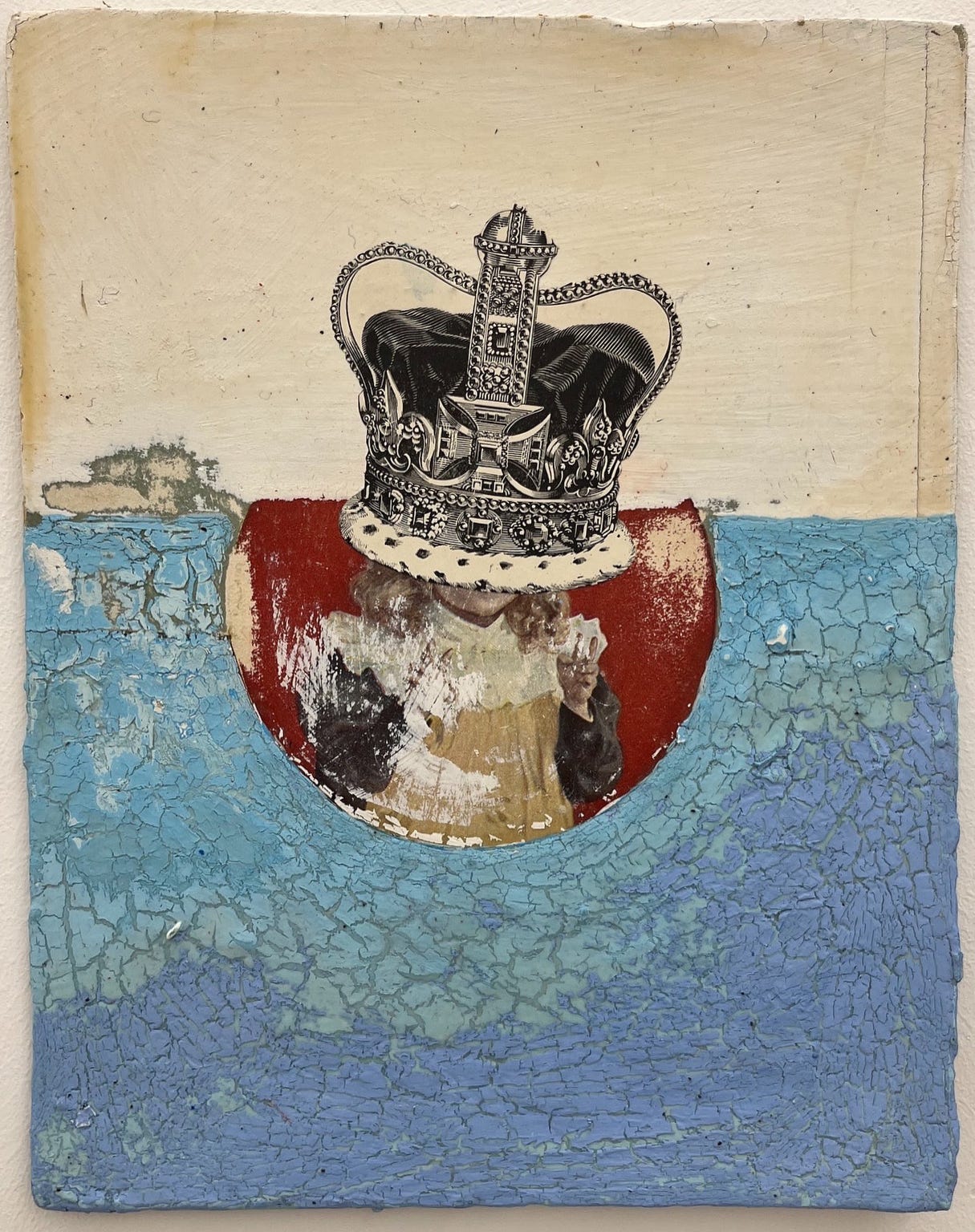
Matthew Rose, Petit Prince, 2015. Collage on board.
«Relationships must deepen or die.» — John le Carré
Summertime in Hackney: The soup cold but good, the sun hot but welcome, the breeze mild and pleasant and the people overweight, foreign, beautiful, seemingly wanting more. Everyone does — no matter who or what they look like or where they come from, the rich as well as the poor.
In August I wandered the cobbled streets around Covent Garden with my mandolin, a busking effort designed to raise some cash to pay for transport, a sandwich, a pint. The pretty, manicured mews and lanes I walked were as laced with the malnourished as they were with the creamy folks who had largely avoided disease, bad teeth, skin rash, anger, distress and of course, hunger.
My narrow musical repertoire tempted handfuls of quick-glancing audiences — a shy child and her mother, a melancholic banker re- membering an Irish dirge I picked, some friendlies from a Middle Eastern country, tourists recognizing an Appalachian melody from their child- hoods; a pretty jogger lured by my take on «Don’t Think Twice» slipped me ten quid; the occasional beggar casually eyed my slowly growing pot of coins.
Playing street music for small change places you a half-step above the bloke laid out blotto by the Tesco with his dirty paper cup. You’re con- sidered poverty-stricken and not wanted, though some children find you and your rendition of Frère Jacques amusing and badger their parents for 50 p to drop in your case. You are tolerated even if you don’t know a single tune or the rusted strings on your broken instrument sing out dull and awkward. You are human — a life — after all. Eventually, the coppers will nudge you along but they (probably) won’t arrest you. Maybe you’re admired for your pluck.
So I was out on the cobblestones entertaining…
A rail-thin London hobo approached me mid-song, waited out a beat and just when I thought he was about to scoop out my earnings he smiled gap-toothed and said with beer breath, «I’ve some good fortune I want to share with you». I imagined his blisters were the result of insect bites from sleeping rough in parks. He confided he ran into some muckety muck feeling positive and he told me the up-and-comer slipped him 100 pounds! My new hobo friend was about to propose the same act of kindness. He pressed a crumpled bill into my hand.
He followed this gesture with a cheerful nod and a fist bump, and limped off, elated at having saved another soul — me, poor me. The hobo probably hadn’t eaten solid food all day or had a bath in a month. He disappeared into a swell of tourist traffic, swallowed up in the maw of London, a vortex of the starving and the well-fed. I looked in my hand. Two 10 pound notes. I thought of David Copperfield.
Twenty pounds is nothing to sneeze at. Perhaps the extra ten a mistake my friend learned about a bit too late? Since I’d already earned twenty pounds on my own steam, I decided to distribute the bounty, no questions asked — a pound here a pound there — to any addict wasted at the Sainsbury door. Cash and a muffin. I handed some change to the 80-year old hobbling towards me; more to an immigrant hard on her luck; a pound to another asleep on a cardboard box; anyone playing music. Anyone asking. I had a budget. It wouldn’t change a life, but the money might buy a bottle of something. Or an orange.
My meager endowment wouldn’t last long in a city of hungry beggars. The well of need is bottomless. As I wondered if people who devote their lives to crushing poverty ever accomplish very much, I distributed coins into open hands, grimy paper cups and chipped dinner plates. Reading John le Carré’s Absolute Friends, I’d earlier asterisked this curious morsel about the hero — which war was he fighting — the last one or the next one?
About to jump on the 19 bus to Arsenal, I spied a man stumbling towards me. «I’m hungry…I’m hungry…I’m hungry» he groaned. It was a sound from a desperate hell. I recognized it and sensed he recognized me in some way — I’d cried like that when my father died. I was terrified. I apologized to him from the steps of the bus and escaped, leaving him on the sidewalk, moaning in hunger.
Why didn’t I help him? I’d helped other people all day, hadn’t I? Or maybe I hadn’t. Maybe I just helped myself with the illusion of being good. What was wrong with me? My head-spinning misery index was high. Was this my conflict? My generosity a game, nothing more? Sure, my poverty could be corrected, but his probably never. I had a friend or two. I had a musical instrument. I had my wits. I had a card to get out of most Hells. Whoever he was, he had little or nothing.
I began to understand this story. If I was starving, it was for love, not food. I was lost but not broken. He was both.
– Matthew Rose is an artist and writer living and working in Paris, France.
This story was so touching. I was touched by the hungry man, but also by you. It is a story of a real world that makes me ache for humanity.
Good story Matthew! So I guess this was from earlier in the year maybe? It might be fun if you did a book of short stories.